
TL;DR
Standard Fleet replaces legacy hardware installations with OEM vehicle API connectivity, allowing fleets to go live in days rather than months. Manage mixed fleets seamlessly with zero downtime or devices.
- Eliminate operational drag
- Universal data normalization
- Instant scalability
Most fleet telematics providers start with a box in the mail and a call to schedule hardware installations. Standard Fleet’s core telematics starts with a VIN list and a consent form. To get your essential data, you no longer need a device, a technician visit, or your vehicle idling in the parking lot while it waits for its turn on the lift.
Traditional telematics onboarding is a multi-week project. For a 100-vehicle fleet, the process from purchase order to full visibility can take four to eight weeks. Every day a vehicle sits in a garage for an install is a day you are losing revenue.
The traditional process involves:
Repeat: Every new vehicle or hardware replacement goes through the same process.
Standard Fleet connects directly to factory-installed modems via our cloud API. For most cars, Standard Fleet’s onboarding process follows three steps:
Upload vehicle identification numbers through the Standard Fleet dashboard. We identify each vehicle’s make, model, year, and connectivity status.
OEM data access requires authorization. We handle fleet-level consent documents and proof of vehicle ownership, such as titles, registrations, or lease agreements.
After consent is processed, Standard Fleet activates the connected vehicle data over the air. Vehicles stream over 1000 unique data points directly from the factory-installed modem.
For most OEMs, activation can take minutes to days, depending on the automaker’s processing timeline. A full fleet can be connected and reporting data within a week.
Fleet managers tend to evaluate telematics based on features and price, but onboarding speed rarely makes the shortlist. Yet the difference between “live in a week” and “live in two months” has real consequences.
Fast onboarding isn’t a nice-to-have. It’s an operational need. Speedily onboarding telematics is the difference between a platform that keeps up with your business as you grow and one that’s always a step behind.
Deviceless fleet management unblocks operational inefficiencies through fast onboarding, but that’s not the only thing. Standard Fleet works the same way regardless of what’s in your fleet. Compatibility with all major car brands allows Standard Fleet to normalize data across every OEM into a single dashboard. One login. One view. One set of reports.
With hardware-based telematics, mixed fleets often mean multiple device types, install procedures, and software platforms. Every OEM addition creates new operational complexity. With software-based onboarding, adding a new OEM vehicle API to your fleet follows the same fast process each time: upload VINs, submit consent, and go live.
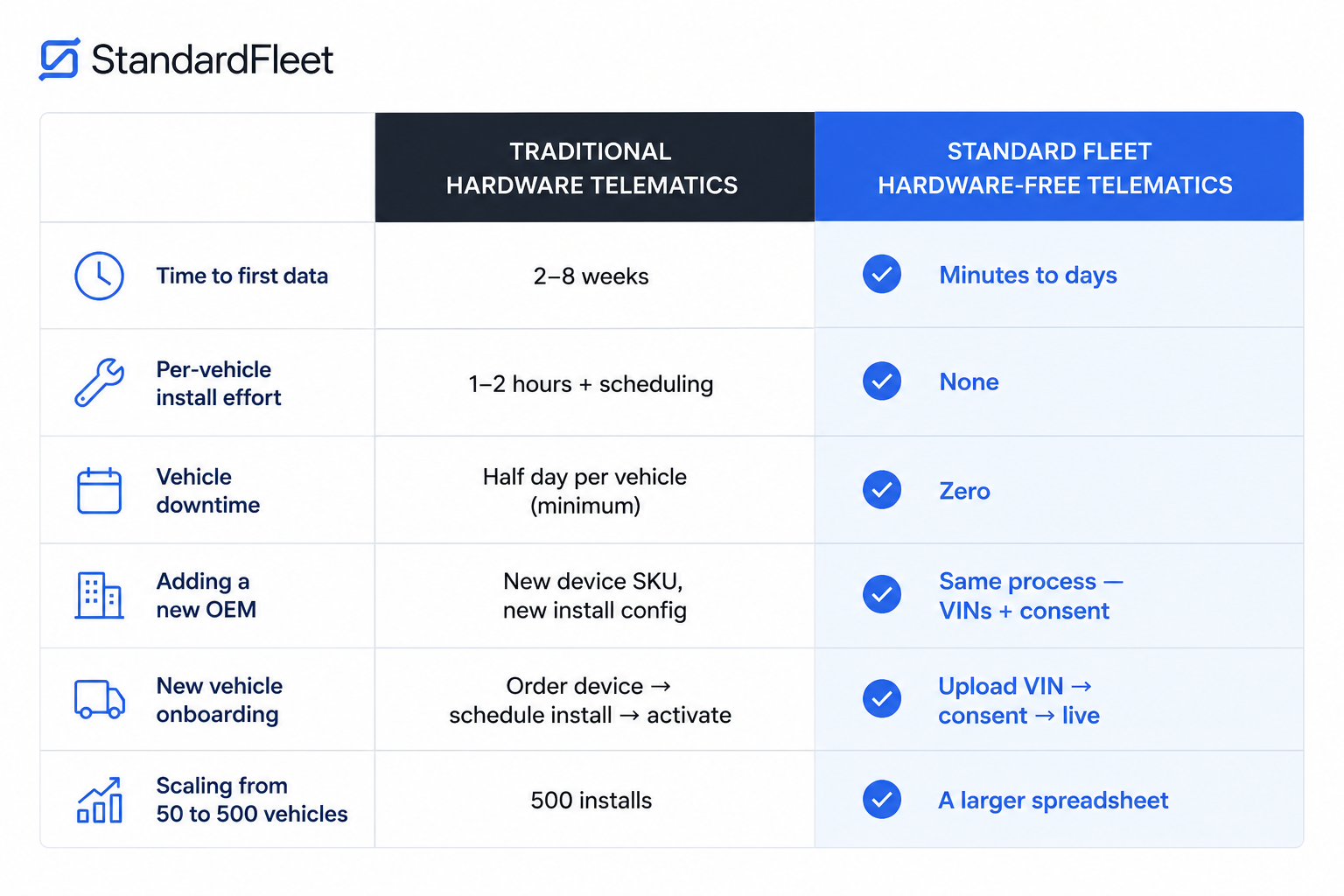
Bypassing aftermarket devices instantly boosts operational visibility. From day one, you gain access to the same underlying vehicle data pulled from the same factory sensors and delivered via connected-vehicle infrastructure. Once a vehicle is connected, fleet operators immediately have access to:
Fleet telematics no longer needs to start with a hardware rollout and weeks of visibility delays. Modern vehicles already have built-in connectivity that streams critical vehicle data via factory-installed systems. Standard Fleet taps into that data directly and takes your fleet live in a matter of days.
Book a 15-minute demo to see how quickly OEM-connected fleet management streamlines your operations.